Leaderboard
728x15
Affichage des articles dont le libellé est Solo. Afficher tous les articles

The Secret Lake the Faller Showed Me

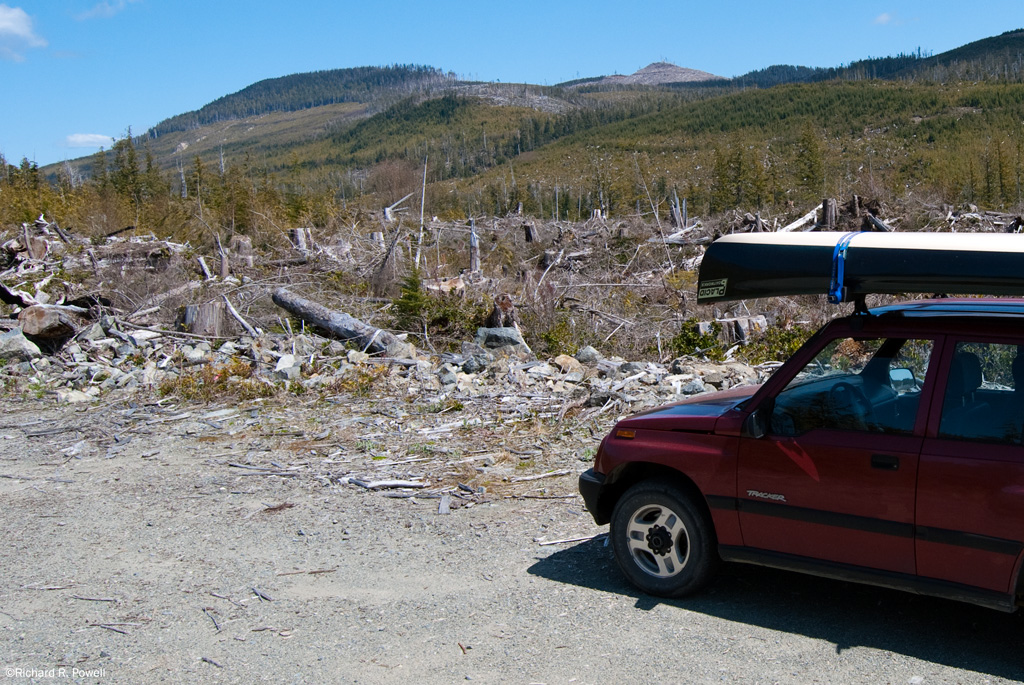
Logged Area Surrounding Black Lake
I have known a few fallers.  As a boy, a timber faller, his dented orange hard hat and red checked jacket, talked to my father at the truck window about the way the earth thumps when the big trunks land. They were big trunks in those days. I watched the man step off the road, over logs, up the bank. His friendly wave before picking up his saw.  The tattered ends of his jeans lifting and dropping on his high shafted boots as he stepped over debris and slash. Dad started the truck, and we headed on to the fishing hole.  I turned in my seat to watch one of the trees at the edge of the cut fall down hill. The springiness of it as it landed.

A faller, his nostrils full of wood dust and the smell of chain oil, feels the power of internal combustion attached to a flying chain of blades, the challenge and exhilaration of dropping large pillars of carbon, tons of wood - the neck stretching openness in the canopy for the blue sky  to step around in fractals between the remaining treetops.

Plug for the gender mold. The archetypal-larger-than-life-macho-logger.  Steel toed boots, the heavy fabric of faller chaps stained with oil, the saw jamming fabric shirt brown with sweat and dirt, the constant current of danger like an eel in a river, the constant numbness in the arms from vibration, the finger tips buzzing.


After the saw is snuffed into silence, after the foam removed from ears, after the sky begins sucking away as much heat as the sun brings in, now low to the horizon - then he stops and ponders the beauty of the place, the funny way the cut opens the forest like an ancient story opens a deepness in the soul. The sweet smell of cut logs mixed with the minty crackle of gum. Good to end a day alive, and then go for a beer with the others in the warm loud span of laughter and forgetting.

A Fire Warden I met on a dusty logging road this summer on the hottest day of the year showed me a lake I could paddle on. His lake. One of his secret spots. He found it years ago when he was a faller. We sat in our vehicles, window to window talking about the changes in the forests - small contractors, more fatalities, a changing way of life. Companies from China securing fibre rights, converting mills to specialty products. And then, he said, he was married to a woman who was Chinese.


The walk to the lake was worth it, he told me, because he had saved a swath of old growth trees. The hillsides around the lake were covered in uniform carpet of new growth as I looked around after easing the canoe into the water from my shoulder.


The same familiar shortness of young trees. But along the edge of the water on one half of the lake a fringe of large trees. The faller's gift. He had asked the timber boss if they could be saved. The saws were already wining their way down the hill overlooking the lake, the trucks hauling away the big cellulose tubes. The boss said no, then a few days later, called back, "OK," he said, "The rest won't be cut." Sort of a miracle.


I paddled and admired the stand of old growth. At the south end of the lake, I tied the boat and walked in the shallow water.


The air was hazy with smoke from distant forest fires. The wind had been blowing earlier but had dropped. The shade of the massive trees seemed to provide an oasis from the heat and smoke.  The pattern of wave splash along the rocks.


They are rugged. They curse and spit and compete and joke. The rough company of men.  The guys who gave me a ride when I locked my keys in my Tracker a few years ago looked at me reluctantly from their Silverado LT 4X4. Working hard not to call me an idiot to my face. In the woods, regardless of how stupid someone is, you help him out.


Almost all the lakes I wish were protected, I accessed from the edge of a logging road. The patchwork quilt of cuts visible from space, and me disappearing like the speckles on a trout's back after you let it go.

on the hillside
a logger steps from log to log
hot saw swinging

Goose Lake

Vancouver Island Backroad Mapbook 4th edition - Map 40 B5
Atlas of Canada Link:Mohun Lake (North)
Latitude and Longitude: 50° 8' 24" N 125° 29' 48" W
Decimal Degrees: 50.14° N 125.497° W
UTM Coordinates: 10U 321589 5557209
Topographic Map Sheet Number: 092K03

Trip Date: July 27 to 30th, 2010

Goose Lake Map

There is a lot of traffic on Goose Lake these days. As the first leg of the Sayward Forest Canoe Route there is a steady stream of canoes and kayaks heading north towards the portage to Twin Lake. The Northern bay has some decent trout in it too, so that brings anglers in skiffs, powerboats, and Zodiacs. The rotting pilings from the old bridges at the narrows keep the water skiers out, but not the jet skis. And it is only going to see more traffic as the population of Vancouver Island increases.

So why am I broadcasting the location to the world wide web? Because I would like to see this fragile and beautiful environment protected so people can keep on enjoying it for a long time to come. As Michel Gauthier points out in his excellent guide to the Canoe Circuit, "By using the resource, we plant a stake in the ground, a flag that represents our will, our wants, and our desire. The more of us who paddle the circuit, the bigger the flag, the more visible it is to them [the policy makers]. We become a constituency. Our use of the resource forces government officials to take us into consideration when they make decisions affecting the area we have claimed."

The beauty of this place may not be grandiose, but it is impressive in it's subtlety.

The first subtle beauty of the place is it's shallowness.


Notice the paddle swirls in the bottom mud behind Paul in this shot? there is something magical about zipping along over the honey colored silt only a few feet below. Schools of stickleback dart away and even the dusky speckled leaches are beautiful to watch as they nose alone sunken logs in search of hiding places.


The golden color comes from the lake bottom which is a soft blanket of decaying algae, pine pollen, and organic matter. In places you can thrust a paddle 4 feet into it without striking anything solid. All the water from Goose and Mohun lakes (and their tributaries) appears to drain out the small creek that leads to Morton Lake. For most of the year the flow is gentle, so the silt has a chance to settle out.

What this means is that it is a great place for aquatic plants to grow, particularly Yellow Pond Lilly, Watershield, Floating Leaved Pondweed, and Water Lobelia.

Floating-Leaved Pondweed
 Here Paul examines a bed of Verticillate Watermilfoil mixed with Widgeon grass:


The Milfoil, a native species, forms slightly disturbing underwater brain structures:


This is sedgebending territory, with a fair number of reeds and rushes for good measure.


The second subtle beauty of this place is the rock. There are a number of rocky islands and points, as well as rocky escarpments and rock gardens.

Rock Garden with Water Lobilia

I think the main rock here is a basalt. According to this map the Goose Lake area sits squarely atop Karmutsen Volcanic Rocks and Quatsino Limestone. One prospector states that "As we head north from Campbell River towards Sayward, the area is almost entirely underlain by Karmutsen basalts near the top of the section." On Goose Lake these volcanic bones emerge in places to add a solid contrast to the softer textures of water and woods.


All of the good campsites have this stone underfoot, but it is particularily obvious at G5, 6, and 7 and the un-numbered site in the Western Bay:

We appreciated the Shade to Eat Our Lunch In

There is a swirl of stone on this point that looks like it may have been a popped bubble of lava:


One of my favorite places on Goose Lake is Lone Tree Island, which I will devote another post to entirely. This island is a large stone projecting from the water with a beautiful pine with undulating roots that stretch out across the rock:


Lone Tree Island contains the third subtle beauty: Pines. Shore Pines to be exact. Also called Bonsai Pines and Bog Pines. The scientific name is Pinus contorta and it is well adapted to growing on rocks and beside the water.

Sunrise over Pine at Campsite G6
Campsite G6 is on the south side of a picturesque island on which are growing numerous beautiful specimens, not least of which are the ones growing in the campsite itself.


The dense "cloud-like" bunches of branches on these specimens make great shade and the trees are strategically located to provide shelter from the sun most of the day.

That tree on the right has a good example of how the pine trunch and branches twist and turn as they grow. Here is a close up:


The contorted pines continue to grace the landscape when they fall down and loose their bark, revealing their beautiful twisted interiors.


 This combination of shallow water, volcanic rock, and trees with deep character make this a place to experience wabi sabi in abundance. It is an experience worth savoring.

I hope that you will visit Goose Lake and tread lightly when you do. But please do visit, and tell your friends, and tell your political representatives that this unique and beautiful treasure needs to be protected, enhanced, and saved for your children and their children.

The campsites need better toilets and some signs to let people know how fragile the environment is. Tables would prevent the cutting of trees and small wooden docks in places would prevent the deterioration of the shoreline habitat.

A big thanks must be given to the Comox Valley Paddlers who have installed the cedar toilet boxes in some campsites.

Lets hope that Ministry of Tourism, Culture and the Arts which now managers the area will receive funding to maintain and protect this valuable natural resource. This is a premier recreational location in western Canada and deserves careful management.


Roberts Lake

Vancouver Island Backroad Mapbook - Map 40 A2

Atlas of Canada Link: Roberts Lake

Google Earth: Type in “Roberts Lake BC” and it will take you right to the lake. There is a Google Earth user photo already on the lake.

Latitude: 50°12'58.15"N
Longitude: 125°32'40.69"W

Trip Date: February 24, 2008

I leave the house at 9:30, the sun is stark in a cloudless winter sky. From the parkway above Malaspina University-College I glimpse open ocean all the way to a fogbank against the mainland. Those poor citizens of Vancouver are shrouded in mist. No sun for them, at least not for several hours. It always feels good to be heading out paddling in sunshine, but somehow doubly good when it is a fortuitous event. The random fate of weather, allowing me to seize the day, while others ponder the ceiling of grey.
Part of the pleasure is knowing that no one is thinking about me, I am a self contained expedition, master of my own destiny. Not expected back till after dark, the whole day spread before me. Solo trips are luxurious, truly incomparably deluxe. A Westfalia van passes me, a couple in their thirties with outdoor jackets and hats. I imagine they are heading for the great outdoors too and speculate on their destination. The woman sees me watching them and I smile dumbly at them, a goof with a canoe in February.

My destination is Hell Diver Lake. Last night I looked up elevations on several lakes. Hell Diver is at 132 meters. Nanaimo’s own Westwood Lake is higher than that at 164 meters with no ice, so I think the water will be open at Hell Diver, but when I get there an hour and a half later, it is frozen over.


Small Lake Below Hell Diver

A small lake below Hell Diver, but just as frozen over...

Hell Diver is a small shallow lake south of Campbell River, so I can see why it might be frozen. I head further North to Quinsam Lake, which is a large deeper lake so perhaps not frozen. But it is at a higher elevation. It’s a gamble, but I head for it anyway. On the Gilson Main I run into snow. In the dip by Gilson Lake I feel the Tracker fishtail through the ruts of previous vehicles. On the hill between Gilson and Quinsam I reconsider. I can see Gilson Lake frozen below me on the right. The ruts in the snow are deep, throwing me around, wheels spin, the load behind the back seat shifts back and forth, paddles knocking together. I look for a turn around. I’ve wasted hours finding Hell Diver and now trying to reach Quinsam. I wonder where the Westfalia folks are and hope they are having better luck. I turn the Tracker around and head back down out of the snow, trying to think where else I can try.

On the Gilson Main On Gilson Main above Gilson Lake

Larry Bowers of West Coast Canoe Company had given me a tip that Roberts Lake was a nice paddle, close to the highway north of Campbell River. I know that another lake near Roberts, Twin Lake, is at 247 meters but I had not looked up Roberts, so I’m left to speculate. I drive into Campbell River and stop to eat a Big Mac and ponder my options. It is 2:00, the sun is past its zenith, but Roberts is a deep lake, I reason, and my curiosity gets the better of me.

On the way past Menzies Bay I catch up to a transport truck, he slows down slightly as we pass a section of planted alders, the sunlight streaming through them across the road. Flash, flash, flash all down the long straight stretch of highway. When we are past the alders the truck speeds up again, the grey trunks and tawny sunshine lingering in my after image, such beauty from such dormant elements.

I watch the snow grow deeper in the ditches all the way up the long hill past the Menzies Lookout, past the turn off to Twin Lake. I am very doubtful that Roberts will be clear of ice. But then the road crests and begins dropping and shortly I see the Roberts Lake Resort sign, and glimpse the lake through the trees. I stop at the rest stop to get my bearings and see that there is a road running along below the highway, right beside the lake. I hop back in the Tracker and find the turn off almost immediately near the northwest corner of the lake.

Roberts Lake Looking North

The water is as still as I have ever seen a lake be. There is literally not the slightest breeze. In the bay there is a small amount of floating clear ice but I take down the canoe and head out onto the water craning my neck to see the snow covered mountains to the east and north. I paddle out across the lake towards the farthest north-eastern corner where a creek drains Cecil Lake. I want to see if it is possible to paddle or portage up the creek to Cecil Lake. Along the northern shore I cruise carefully looking at large rocks just under the surface. Some have black tops, with dead algae below. I deduce that they stand above water part of the year, the algae line indicating the usual water level. The lake is full but the water is clear and still, I can see the rocky bottom as it curves steeply over a sharp underwater drop into darkness.

In the bay near the creek a wooden structure stands on a point, bones of a summer camp. Buoys float without moving in the lake. I imagine that in the summer boats, power boats even, dot this shore, oil spilling across the pristine surface. I listen for voices, laughter, splashing children, but it is quiet as velvet, only the small whisper of the creek running out across gravel.

The sound of the hull contacting with the gravel rouses me and I clamber out to stretch my legs. I spend some time examining stones along the shore. The gravel is uniform in size but sharp edged. This is a young place, the stones have not been smoothed overly, they are recently cracked apart, but the uniformity is pleasing.


Back in the canoe I paddle down the eastern shore, past another long dock and along a small island. Then, in the distance a large boulder on the shore catches my eye and I paddle towards it. Someone has constructed a very precarious looking diving board on top of it. I look into the water below it and can not see a bottom. I look at the shore to discern a camp or building. There is no obvious clearing.

I paddle around the point and towards the second inflow. There is another point, then a sandy bay, then a cluster of shrubs with red branches. As I paddle closer I see that the branches are a variety of shades from orange to pink to red. These bushes are worth the whole trip. I rest my paddle and stare at them, the canoe gliding silently, the sun angling towards the horizon.


Roberts Lake on a sunny February day consumes my visual field. Dark grey almost black rocks roughly cut but slightly smoothed, bleached logs, rippled sand, dormant vegetation armoured in color, the sun drawing out all pigment, exposing subtle variations in texture and pattern.


My muscles warm as I paddle back across the lake to the vehicle, the sun winking out behind the hill. Like an unexpected jewel on a grey stony shore, this unexpected winter beauty has been mine all day, and if feels as if no one else knows about it. A gem sitting in plain view along highway 19. It would be a nice place to set up a Westfalia.

More pictures of Robert Lake are located on my Flickr pages at:
http://www.flickr.com/photos/stillinthestream

Text and photos © Richard R. Powell

Why


(WARNING: This post contains a discussion of Pothunting)

George Washington Sears, pen name Nessmuk, wrote a series of letters to Field and Stream Magazine from 1880 to 1885 about his solo canoe trips through the Adirondacks. The canoes he paddled were small and light because he was an older man with asthma. He went to the woods for his health, believing clean air to be a balm like no other. “Go light,” he advised, “the lighter the better, so that you have the simplest material for health, comfort, and enjoyment.”

I like George, meeting him all these years later though his stories. He was an observant person who loved remote places but did not shun people....well most people. He did shun certain types of people.

“I love a horse, a gun, a dog, a trout and a pretty girl. I hate a pothunter, a trout-liar, and a whisky-guzzling sportsman.” Sears wrote these words and others like them because he saw how men of this sort spoiled the woods, lakes, and rivers.

A pothunter is a hunter who hunts with disregard for rules and conservation and who lacks appreciation for the value of animals apart from their role as objects to kill, possess, or display. A pothunter seeks a prize to show to his friends, a trophy to give him bragging rights. Sears liked to hunt and fish, but not as a means to build his ego, not for show or prestige.

When I first came across references to him, I expected not to like him. I generally don’t like people who start movements. They are driven. Driven people make me nervous. The movement he started (solo canoeing) is sometimes twisted into pothunting of a different sort. I’m talking about outdoor types who show off their survival skills, endurance, courage, and competitive edge in order to impress or awe others.

But Nessmuk isn’t like that. He is a bit the opposite, and while he was not a saint or heroic icon, he comes close to embodying a way of being in the wild that feels right to me. In this he reminds me of my father. Like Nessmuk, my father loved fishing and hunting for their own sake, and cared little what others thought of the sport or his prowess with a gun, bow, or rod. He just liked it and when we went out together it wasn’t overly important if we arrived home empty handed. Dad didn’t brag and while he told stories of “the one that got away,” they were almost always relatively accurate. I knew they were accurate, because most of the time I had been there.

I plan to write about dad, our times together, and the values he passed on to me, but for now, I just want to be clear that what I am after, the reason I am doing this project, is to define one of many alternatives to pothunting. I’m certainly not the first to attempt such an exercise, but I do want to include my voice.

Another reason I am going is to learn to read again.

Karen Armstrong in an interview with Tapestry Producer Mary Hynes describes a time in her life when she was defeated by poor health and life circumstances and turned to the study of the great texts of world religions. Because she was no longer surrounded by noise and activity, all alone in her apartment, she was suddenly able to hear the poetry of the writers, and enter into the realities behind the words.

Much of my reading lately has become speed reading, rushing through one book or another looking for content, for a specific answer, for data, facts, information. I want more than that, I want the meditative absorption that comes from reading a book in the company of great silence.

So I will be reading Nessmuk, and other great nature writers. And I will be reading Taoist texts and maybe some other religious texts, I’m not sure yet. I want to read Ursula Goodenough’s Sacred Depths of Nature because I intuit that Ursula knows something important, something I need to know.

I also want to learn again to read nature, to “notice” it in the great Buddhist sense. This is why I paddle, why I have embarked on this experiment. The Japanese poet Basho spoke of his travels across Japan as a journey into the deep interior of his country. I will be traveling into the deep interior of this island I call my home.
Leaderboard